

- Simple electric circuit In the simple electric circuit shown in Fig 1, the current completes its path from the positive terminal of the battery via the switch and the load back to the negative terminal of the battery. The circuit shown is a closed circuit. In order to make a circuit to function normally the following three factors are essential.

- Electromotive force (EMF ) to drive the electrons through the circuit. • Current (I), the flow of electrons. • Resistance (R) - the opposition to limit the flow of electrons.
- Ohm’s law In 1826 George Simon Ohm discoverd that for metallic conductor, there is a substantially constant ratio of the potential difference between the ends of the conductor Ohm’s law gives the relation between the voltage, current and resistance of a circuit. Ohm’s law states that the ratio of the voltage (V) across any two points of a circuit to the current (I) flowing through is constant provided physical conditions, namely temperature etc. remain constant. This constant is denoted as resistance (R) of the circuit. (or) In simple, Ohm's law states that in any electrical closed circuit, the current (I) is directly proportional to the voltage (V), and it is inversely proportional to the resistance 'R' at constant temperature.
I ∝ 1/R (When 'V' is kept constant)
I ∝ V/R (Relation between I, V, and R)
I ∝ V / R
It means I = V / R
V = Voltage applied to the circuit in 'Volt'
I = Current flowing through the circuit in ‘Amp’
R = Resistance of the circuit in Ohm (Ω)
- Open circuit- In an open circuit, there is an infinitely high resistance in the circuit. This condition can happen in a circuit when the switch is open. Therefore, no current of flow. For example, a generator is said to be in an open circuit when the switch is open and running without supplying current to the circuit. A wall socket, too, is an open circuit if the control switch of the wall socket is ‘OFF’or 'ON' position provided there is no appliance plugged to the wall socket.
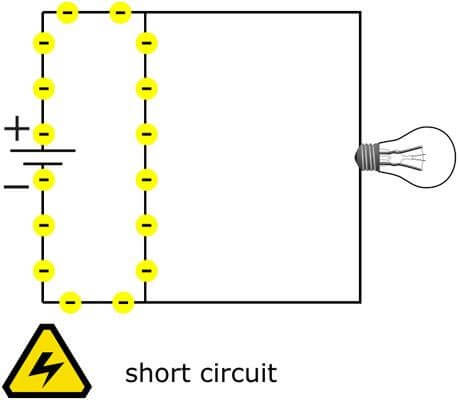
- Short circuit The other important extreme condition is the short circuit. A short circuit will occur, for example, when the two terminals of a cell are joined (Fig 9). A short circuit may also occur if the insulation between the two cores of a cable is defective. The resulting negligible resistance will cause large currents which can become a hazard. A fuse, if provided in the circuit as shown in Fig 9, could then blow and automatically open the circuit.
Work
-
Definition: Work is said to be done when a force is applied on an object and it causes displacement.
-
Formula:
-
Unit: Joule (J)
-
1 Joule: Work done when a force of 1 Newton moves an object 1 meter in the direction of the force.
⚡ Power
-
Definition: Power is the rate at which work is done or energy is transferred.
-
Formula:
-
Unit: Watt (W)
-
1 Watt: When 1 Joule of work is done in 1 second.
Other Units:
-
1 kilowatt (kW) = 1000 W
-
1 horsepower (HP) = 746 W
🔋 Energy
-
Definition: The capacity to do work.
-
Types: Kinetic, Potential, Electrical, Thermal, etc.
-
Unit: Joule (J)
-
Electrical Energy:
-
Commercial Unit: kWh (kilowatt-hour)
-
1 kWh = 1000 W × 3600 sec = 3.6 × 10⁶ J
-
🚜 Indicated Horsepower (IHP)
-
Definition: The total power developed inside the engine cylinder.
-
Formula (for reciprocating engines):
Where:
-
P = Mean effective pressure (kg/cm²)
-
L = Stroke length (m)
-
A = Area of the piston (cm²)
-
N = Number of power strokes/min
-
⚙️ Brake Horsepower (BHP)
-
Definition: The usable power output available at the engine crankshaft (actual output).
-
Measured using a Dynamometer.
-
Always less than IHP due to mechanical losses.
🛠️ Frictional Horsepower (FHP)
-
Definition: Power lost due to friction between engine parts.
🧾 Electrical Bill Calculation
-
Energy Used:
-
Cost of Electricity:
Example:
If you use a 1000 W heater for 5 hours a day for 30 days and the rate is ₹6/unit:
- Kirchhoff's law and its applications Kirchoff's laws are used in determinig the equivalent resistance of a complex network and the current flowing in the various conductors.
- Kirchhoff's first law: At each junction of currents, the sum of the incoming currents is equal to the sum of the outgoing currents. (or) The algebric sum of all branch currents meeting at a point/node is zero

- Kirchhoff's second law A simple case: In closed circuits, the applied terminal voltage V is equal to the sum of the voltage drops V1 +V2 and so forth. If all the generated voltages are taken as positive, and all the consumed voltages are taken as negative, then it can be stated that: in each closed circuit the sum of all voltages is equal to zero. ∑V = 0

- Key Characteristics of DC Parallel Circuits:
- Common Voltage: All components in a parallel circuit experience the same voltage. Multiple Paths: The current splits into multiple paths, flowing through each parallel branch.
- Total Current: The total current drawn from the source is the sum of the currents flowing through each branch.
- Branch Currents: The current flowing through each branch is inversely proportional to the resistance of that branch.
- Equivalent Resistance: The total resistance of a parallel circuit is less than the smallest individual resistance. The reciprocal of the total resistance is the sum of the reciprocals of the individual resistances.


- Independence: If one component fails, the other components in the circuit continue to function.
- Constant Voltage: Each component receives the full voltage, ensuring consistent performance. [
- High Current Capacity: Parallel circuits can handle higher currents compared to series circuits.
- Home Lighting: Multiple light bulbs in a room are connected in parallel, ensuring that if one bulb fails, the others remain lit.
- Electrical Receptacles: Multiple outlets in a house are connected in parallel, allowing different devices to draw current independently without affecting the others. Parallel circuits offer a way to connect multiple components to a common voltage source, allowing for independent operation, consistent voltage across all branches, and the ability to handle higher currents.

- Effects due to short circuit Excess current due to short circuit can damage the circuit components, power sources, or burn the insulation of connecting wires. Fire is also caused due to intense heat generated in the conductors.
- Protection against dangers of short circuit Dangers of short circuit can be prevented by means of fuses and circuit breakers in series with the circuit. Detecting short circuit When the ammeter in the circuit indicates excessive current then it indicates a short circuit in the circuit. The location of short in a circuit can be detected by connecting a voltmeter across each of the elements (resistors) and circuit source. If the voltmeter indicates zero volts or reduced voltage across the element, it is short circuited as shown in diagram.
- Methods used to protect the circuit in case of a short circuit As heavy currents flow through the short circuit, the circuit cables should be protected against the large currents. If the short circuit current is allowed to flow through the circuit, the cables which are rated for normal circuit current, will get heated up and become potential fire hazards. To open the circuit automatically in cases of short circuits, fuses or circuit breakers are used in the circuit. The rating of the fuse wire or setting of the overload relay in circuit breakers will be selected depending upon the lowest rating of any one of the following used in the circuit. i Load current in the circuit ii Cable rating of the circuit iii Series meter (ammeter etc.) rating of the circuit
- Open circuit in series circuit
An open circuit results whenever a circuit is broken or is
incomplete, and there is no continuity in the circuit.
In a series circuit, open circuit means that there is no path
for the current, and no current flows through the circuit. Any
ammeter in the circuit will indicate no current as shown in

- Causes for open circuit in series circuit Open circuits, normally, happen due to improper contacts of switches, burnt out fuses, breakage in connection wires and burnt out resistors etc. Effect of open in series circuit
- a No current flows in the circuit.
- b No device in the circuit will function.
- c Total supply voltage/ source voltage appear across the open.
- Determination the location of break in the circuit has
occurred
Use a voltmeter on a range that can accommodate the
supply voltage; connect it across each connecting wire in
turn. If one of the wires is open as shown in Fig 4, the full
supply voltage is indicated on the voltmeter. In the absence
of a current, there is no voltage drop across any of the
resistors. Therefore, the voltmeter must be reading full
supply voltage across the open. part of the circuit
- Voltmeter reading = 18 V – VR1 – VR2 – VR3
- Practical application With the knowledge gained from this exercise: • locate open and short circuit faults in a series circuit • repair series-connected decoration bulb sets.
Understanding Short and Open Circuits: Essential Electrical Safety
When it comes to electrical circuits, two common defects can lead to significant problems: short circuits and open circuits. Understanding them is crucial for anyone dealing with electricity, whether you're a DIY enthusiast or just want to grasp how your home's wiring works.
- The Open Circuit: A Break in the Path
.png)
.png)
Think of an open circuit as a break in the electrical path. It's like a bridge that's out – no current can flow from one side to the other. This can happen due to:
- Loose connections: Wires not properly connected.
- Broken wires: A physical break in the conductor.
- Switch in the "off" position: Intentionally opening the circuit.
What happens? The circuit stops working. If it's a light, it won't turn on. If it's an appliance, it won't function. While an open circuit prevents the flow of current, it generally doesn't cause damage to components itself.
The Short Circuit: The Dangerous Shortcut
A short circuit is a much more dangerous scenario. It occurs when electricity finds an unintended, low-resistance path, bypassing the normal components of the circuit. Imagine water flowing down a river, and suddenly there's a steep, direct path that takes it away from the normal winding course.
Why is it dangerous?
- Massive Current Flow: Because the resistance in a short circuit is extremely low (ideally zero), an enormous amount of current tries to flow.
- Excessive Heat: This massive current flow generates a huge amount of heat.
- Damage and Fire Risk: This heat can quickly melt wires, damage components (like switches, cables, and other circuit elements), and even cause fires.
How to prevent damage from short circuits?
This is where safety devices come in! To protect against the dangers of short circuits, electrical systems use:
- Fuses: These are designed to melt and break the circuit when current exceeds a safe level. They are often placed to protect the total current flow or even specific branches of a circuit.
- Circuit Breakers (MCBs - Miniature Circuit Breakers): Similar to fuses, circuit breakers automatically "trip" and open the circuit when they detect an overcurrent, but unlike fuses, they can be reset.
An open circuit stops the show, but a short circuit can start a fire. Always ensure your electrical systems are properly installed and protected with the right safety devices to prevent dangerous short circuits. Safety first when dealing with electricity!